

Evaluation of Stress Tolerant Orphan Legumes (STOL) for use in dryland farming systems across sub-Saharan Africa and India – promoting India- Africa Framework for Strategic Cooperation (Phase II)


Dr Kuldeep Tripathi and Dr Bhaskar Bajaru with the farmers who participated in the Bambara Groundnut Awareness Programme conducted at ICAR-NBPGR Regional Station, Hyderabad, on 2 April 2026.
PROJECT OVERVIEW
Background
This project aims to enhance food and nutrition security in India’s arid and semi-arid regions by introducing and improving Bambara groundnut (Vigna subterranea (L.) Verdc.), an underutilised, nutrient-dense legume indigenous to Africa. Known for its drought tolerance and ability to thrive in low-fertility soils, Bambara groundnut offers a sustainable option for resource-poor farmers in rainfed farming systems, where crops such as groundnut and pigeonpea are increasingly affected by harsh climatic conditions. Rich in dietary fibre, protein, iron, potassium, calcium, and B vitamins, Bambara groundnut is considered a near-complete food and provides a cost-effective means of addressing protein deficiencies in vulnerable communities. However, its wider adoption has been limited by low yields, long cooking times, pest susceptibility, and limited breeding efforts.
The initiative will introduce and test Bambara groundnut germplasm from the International Institute of Tropical Agriculture (IITA), the University of Nottingham, and African genebanks, focusing on drought tolerance, pest resistance, and higher yield potential. Around 500 accessions will be evaluated across agroecological zones in Delhi, Hyderabad, and Cuttack. A new core collection will be established based on yield stability, resistance to major biotic stresses, and nutritional quality, with promising accessions supporting breeding programmes in India and Africa. The project aims to strengthen climate-resilient agriculture, promote crop diversification, and enhance food security in India’s dryland regions.
Objectives
-
Strategic germplasm exchange and conservation.
-
Multi-environment evaluation for climate resilience.
-
Development of an India-adapted core collection.
-
Strengthening India–Africa South–South Cooperation.


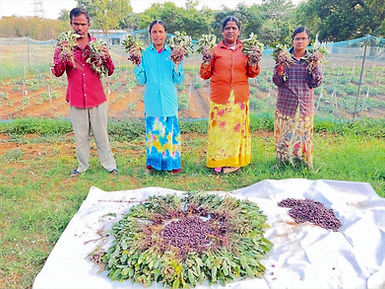
Top two photos: Scientists and farmers from Nirven Village, Wanaparthy District, Telangana, participate in the Bambara Groundnut Awareness Programme held at the ICAR-NBPGR Regional Station, Hyderabad, on 2 April 2026. The event showcased the diversity and potential of Bambara groundnut and provided an opportunity for interactive discussions between researchers and farmers on the crop's cultivation, improvement and future prospects.
Bottom photo: Farmers and scientists at the Bambara Groundnut Awareness Day held in Cuttack, Odisha, India, in April 2026.
PROJECT TEAM

Dr DK Yadava
Project Director
ICAR-National Bureau of Plant Genetic Resources (NBPGR), India

Dr Kuldeep Tripathi
PI
ICAR-National Bureau of Plant Genetic Resources (NBPGR), India

Dr Bhaskar Bajaru
Co-PI
ICAR-National Bureau of Plant Genetic Resources (NBPGR), India
